
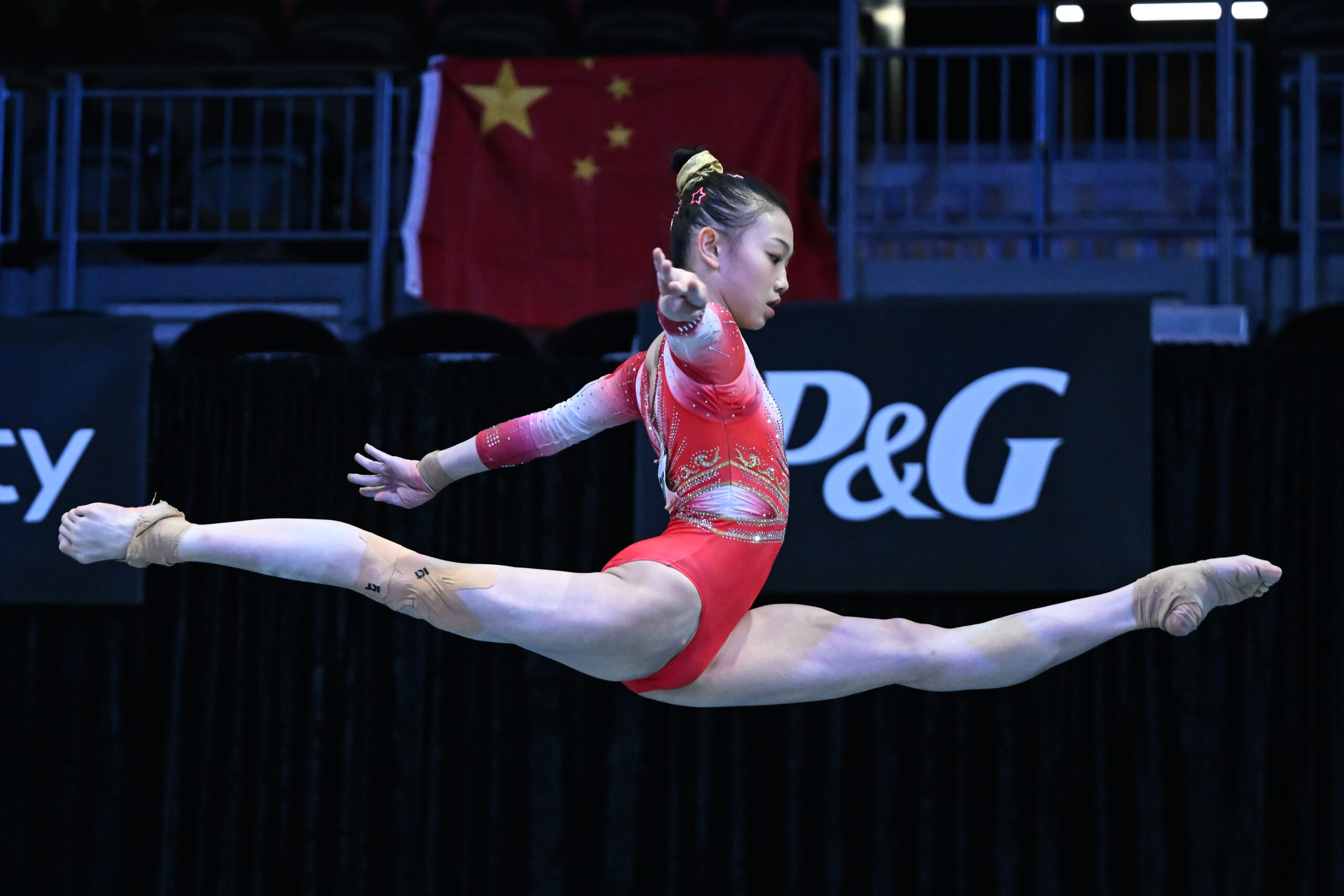
With the 2026 World Artistic Gymnastics Championships in Rotterdam less than a week away, the competition is officially starting to heat up. As the nominative roster becomes official and gymnasts start to make their way to the Netherlands, we are starting to get a clearer picture of who may be in contention for both finals and medals.
While we have gotten used to American dominance in the women’s team event over the last decade and a half, the tide may finally be changing. The last time Worlds was held in Rotterdam – 2010 – was the most recent world championships to feature a team final winner other than the United States (Russia).
Many teams will be heading into the competition with hopes of outperforming the expectations of yesteryear, and plenty have the talent to back up their goals. Starting with Asia and Oceania, we are making our way through the women’s teams most poised to make the team final in order to give you a sense of the stakes heading into the first Los Angeles 2028 Olympic Qualifier.
As a reminder, the top three teams in this year’s team final will earn tickets to LA, with nine more teams to be named at next year’s championship.
China
The Team
Despite bringing top talent year after year, China’s struggles with consistency have caused it to miss every World and Olympic team podium since 2019. However, this year’s team seems like China’s most complete in years, and it may be just enough to change the global gymnastics landscape ahead of the Olympics in 2028.
The team is headlined by a couple of established stars with the hardware to match – Zhang Qingying and Qiu Qiyuan. Zhang was a breakout star at last year’s Worlds, taking home the gold medal on beam and finishing third in the all-around final. While potential all-arounder Qiu has been limited slightly since her 2024 Olympic appearance, only having competed three vaults since Paris, she looks to be in top form on her best events: bars and beam.
Zhang and Qiu will be joined by 2024 Olympian Zhang Yihan, along with 2018 Worlds alternate Du Siyu and breakout first-year senior Ke Qinqin.
Unlike many other top medal contenders, the Chinese team has plenty of experience meeting big moments together, with these same five gymnasts winning the team titles at both Asian Games and Asian Championships. In particular, the 168.498 that China scored at Asian Championships is a solid benchmark to judge top teams by, and it should be more than enough to factor into the medal standings.
The Breakdown
Vault has been an Achilles’ heel for China for the last decade, often holding back otherwise medal-worthy teams from reaching their true potential. Though the Chinese team does not include Deng Yalan, who qualified for last year’s world vault final before pulling out, it does still feature a competitive lineup of three 5.0+ difficulty vaults.
Du leads the pack in scoring this season, narrowly beating out Zhang Yihan for the national vault title. Her double-twisting Yurchenko plus front handspring pike half may not be the most difficult combo, but it is probably China’s most reliable and has some potential event final upside should things go south for top competitors.
As nationals proved, Zhang Yihan is hot on Du’s heels, boasting China’s most difficult pair of vaults: a Tsuk double and front handspring pike half. Zhang’s Tsukahara vault is one to watch. She has struggled with consistency and form throughout the year, but a solid hit will go a long way in maximizing China’s team score. Ke will surely be in the mix after recently upgrading to a double-twisting Yurchenko with mixed results, with Zhang Qingying’s Tsuk full being the most likely option to fill out the lineup (though Qiu did vault in the qualification round of Asian Games).
Even with 2025 world bars medalist Yang Fanyuwei not making the trip to Rotterdam, China may very well still end up being the top-performing team on bars. When she’s on, few in the world can match 2024 Olympic silver medalist Qiu’s scoring potential. Though her consistency this year has been lacking compared to her 2024 campaign, her gold medal-winning 15.100 at Asian Games suggests that she has every intention of challenging for the world podium. Yang’s absence has perhaps opened the biggest door for Du, who has struggled to make teams in the past as, effectively, a two-event specialist. Outside of a fluke routine during Asian Games qualification, every one of Du’s bars routines this year has scored at least 14.233. Zhang Qingying and Ke both generally hover around the 14 mark, though it is a promising sign that Ke’s top score this year came at Asian Championships and not a domestic meet.
Beam is likely China’s most straightforward lineup – Du has not competed the event since early 2025 – and has the potential to be one of, if not the most impressive collective shows of gymnastics at Worlds this year. Reigning world champion Zhang Qingying looks primed to repeat, having both the highest credited difficulty (6.9) and overall score (15.333 at Asian Championships) among all gymnasts worldwide in 2026. Ke is not far behind, delivering stunning technical precision en route to a 6.7 difficulty score. Zhang and Ke are the only two gymnasts to score above 15 on beam this year in international competition, and they very well may finish first and second in the beam final if they can hit to their full potential.
Though Qiu is seemingly no longer competing her uber-difficult back handspring to Arabian combo, she’s still one of the top beam workers in the world. If she brings the acro series back, things could get complicated at the top of the standings with the two-per-country rule.
Floor looks to be China’s least deep event, considering Du has not competed it this year and Qiu has only competed twice. As the presumed all-arounders, Ke and Zhang Qingying are locks for the floor rotation. They do not have the highest scoring potential, but the low to mid 13s are a solid benchmark for what a hit looks like. Zhang Yihan has generally been around the same range, but she had a breakout moment during the Asian Championship event final, scoring an international career-high 14.066. She brings big tumbling – a Silivas and triple twist to front tuck – which may be just enough to secure an event final spot with a hit.
Japan
The Team
If we had to pick a breakout gymnast of the year for 2025, Japan’s Aiko Sugihara would be near the top of the list. A decade removed from her 2015 World Championships debut, Sugihara won her first major international medals – bronze on beam and gold on floor. Fresh off an Asian Games performance that included gold medals in the all-around and on floor, Sugihara looks to be performing some of the best gymnastics of her career.
Though Sugihara’s success has been a top storyline, the Japanese team as a whole looks to be the strongest in recent memory, and it may be the federation’s best chance at a team medal since last making the podium in 1966. Joining her in Rotterdam will be 2025 team members Rina Kishi, Haruka Nakamura, and Mana Okamura, along with reigning 2025 junior world floor champion Misa Nishiyama.
Similarly to China, Japan’s world team is the same group that won the silver medal at Asian Games, giving some insight into what strategy the country might use for its lineups.
The Breakdown
Japan is in a particularly interesting position, having to choose whether to prioritize qualifying gymnasts to event finals or putting up three all-arounders in qualifications. At Asian Games, they went with the latter, with Nishiyama, Kishi, and Sugihara competing all four events in the qualification round. Any of the three are more than capable of making the world all-around final on any given day, but if one had to go, it would likely be Kishi, who finished third amongst her compatriots.
Though none of Japan’s squad has competed a second vault this year, meaning no one will be challenging for the event final, vault still projects to be an asset for the team. Sugihara leads the pack with a stunning double-twisting Yurchenko that she debuted this year, with Kishi’s not far behind. Nishiyama has also scored well throughout the season, though there is a noticeable drop in form from her teammate’s double-twisting Yurchenko to hers. Okamura (Tsuk full) and Nakamura (full-twisting Yurchenko) are both options for the fourth qualification spot, though Okamura may have a slight edge after being Japan’s fourth vaulter at Asian Games.
Bars is likely to be Japan’s weakest event, though more so due to consistency concerns than a lack of talent. Nishiyama is a stunning bars worker when she’s on, competing a mind-blowing jam to full-twisting Jaeger (Yang) combination. She will be looking to make the event final, with some podium potential should things shake out in her favor.
Okamura is probably the next best option, hitting the 14 mark at both Asian Games and Championships. Bars is what is currently holding Sugihara back from being a true all-around superstar, but she is good enough on the other events to warrant competing in the all-around in qualifications. Nakamura is likely the next best bars worker on the team, with her eponymous piked Deltchev being a highlight, but consistency is a major concern. She has scored as high as 14.133 this year domestically, but also has a full meltdown for a 9.833 on her record. Likely due to these consistency issues, the Japanese federation chose not to use Nakamura on bars at all during Asian Games, both in qualifications and the team final.
Beam has been a consistent source of success for Japan, with five different gymnasts winning medals on the event across the last four World Championships. Reigning bronze medalist Sugihara will surely be looking to return to the event final, and she has even upgraded her routine slightly since last season, adding a back handspring after her switch ring for an extra tenth. Fellow 2025 beam finalist Okamura also looks ready to return to the final. Her dance elements may not be quite as crisp as Sugihara’s, but she makes up for it with floaty acrobatic skills, including a side aerial to layout stepout acro series. Nishiyama will likely also perform beam in qualifications to secure an all-around berth.
Similarly to bars, Nakamura may have the most potential of the whole team, but once again, consistency struggles kept her from competing the event in qualifications at Asian Games. While Kishi is a more consistent beam worker, Nakamura’s recent scores – including a 15.133 at the Japanese National Sports Festival in early September – may be too good an opportunity for the federation to pass up.
Once again, Sugihara will anchor the Japanese floor rotation with her world-class routine. Kishi is the most likely to join her, having hit the elusive 14 mark twice this year already. Nishiyama has been peaking at the right time, scoring a career-high 13.900 en route to the silver medal at Asian Games only a few weeks ago. This leaves one additional spot for either Okamura or Nakamura, which largely depends on which direction Japan wants to go with its all-arounders.
Floor was the only event Nakamura competed during the qualifying round of Asian Games. Should the Japanese federation deem her risky bars and beam routines worthy of an all-around spot, she will likely take the final floor lineup spot, along with Okamura’s vault spot. If they choose to play it safe, Okamura still boasts a solid routine.
As has been the case with seemingly all Japanese teams over the past few seasons, the question in terms of medal potential has nothing to do with talent. These five gymnasts can easily challenge for a podium spot – or potentially even a win – on their best day, but they are one major miss away from free falling in the standings, much like what happened in the last seconds of the team final at 2022 Worlds.
Australia
The Team
For all intents and purposes, 2025 Worlds was a success for Australia, with Kate McDonald becoming the first Aussie gymnast to make an event final since Larissa Miller in 2014. This year, all three members of the 2025 squad – McDonald, Ruby Pass, and Breanna Scott – are back, joined by Romi Brown, Lucy Stewart, and Emily Whitehead. Interestingly, the Australian federation is yet to officially name an alternate, leaving their team prospects fairly open-ended in the weeks leading up to the championships.
No matter who ends up on the official squad, one gymnast who will certainly be missed is reigning national all-around silver medalist Georgia Godwin. Godwin has been a staple on the Australian team for the last decade-plus since making her Worlds debut in 2015, but she has struggled with injuries over the past few seasons. 2026 looked like a solid bet for the 28-year-old to make her first Worlds appearance since the Paris quad, but a last-minute decision to pull out of contention left Australia without, perhaps, its biggest asset.
The good news is that Australia’s world team is largely the same as its Commonwealth Games squad from July, with Brown/Stewart taking the place of Godwin, giving us a solid standard by which to assess its international scoring potential. While placing in the top three and landing a 2028 Olympic qualification spot is almost certainly out of the question, Australia will be looking to make the world team final for the first time since 2014.
The Breakdown
Vault projects to be a solid, if not particularly difficult rotation. Whitehead and Pass lead the way with a pair of Yurchenko 1.5s, joined by Scott and Brown, who each vault Yurchenko fulls (though Scott has toyed with a 1.5 in training). McDonald is seemingly a nonfactor on vault, having only competed the event at one competition over the last four years. Though Stewart’s score likely would not be counting in a 4-up, 3-count scenario, if she was named to the team, McDonald’s lack of vault would leave Australia putting up her Yurchenko layout in qualifications.
Bars presents a big opportunity for the Aussie squad, and it looks to be their most competitive event in terms of potential qualifying to finals as well. On top of a reigning event finalist in McDonald, Ruby Pass has also scored as high as 14.233 this season domestically (though none of her other routines this year have broken 13.4). Brown, Scott, and Whitehead all score similarly, maxing out around the low-to-mid 13s. The decision of which two join Pass and McDonald in qualifications likely revolves around who Australia wants to put up in the all-around, thus favoring Scott and Whitehead – who both made the podium at Australian Championships.
Beam is a similar story to bars. Scott, the reigning Commonwealth Games champion, is an event final hopeful with the potential to score into the mid 14s. Pass has also scored as high as 13.7 this year, but with the high highs have come low lows – while 50% of Pass’ 2026 beam routines have scored above 13.5, the other half have been sub-12 scores with the potential to derail any team final aspirations. In that sense, beam is where Stewart’s potential utility is most realized. Though she’s had some consistency issues of her own, her extension and execution, particularly on dance elements, put her a step above other options. As a potential all-arounder, Whitehead is the most likely choice for the last beam spot in qualifications, though McDonald may have slightly higher score potential.
Floor may be where Godwin’s absence is felt the most, as she was competing the most difficult routine of her compatriots. Similarly to beam, floor will be an area where Stewart could step up to fill the gaps, consistently scoring in the low 13s range. Scott would certainly be joining her, raising the question of whether to prioritize maximizing the team score or putting up three all-arounders in qualifications. If the latter is the priority, both Pass and Whitehead would be the likely choices. If not, McDonald could slide into one of their places (likely Whitehead’s).


Leave A Comment
You must be logged in to post a comment.