
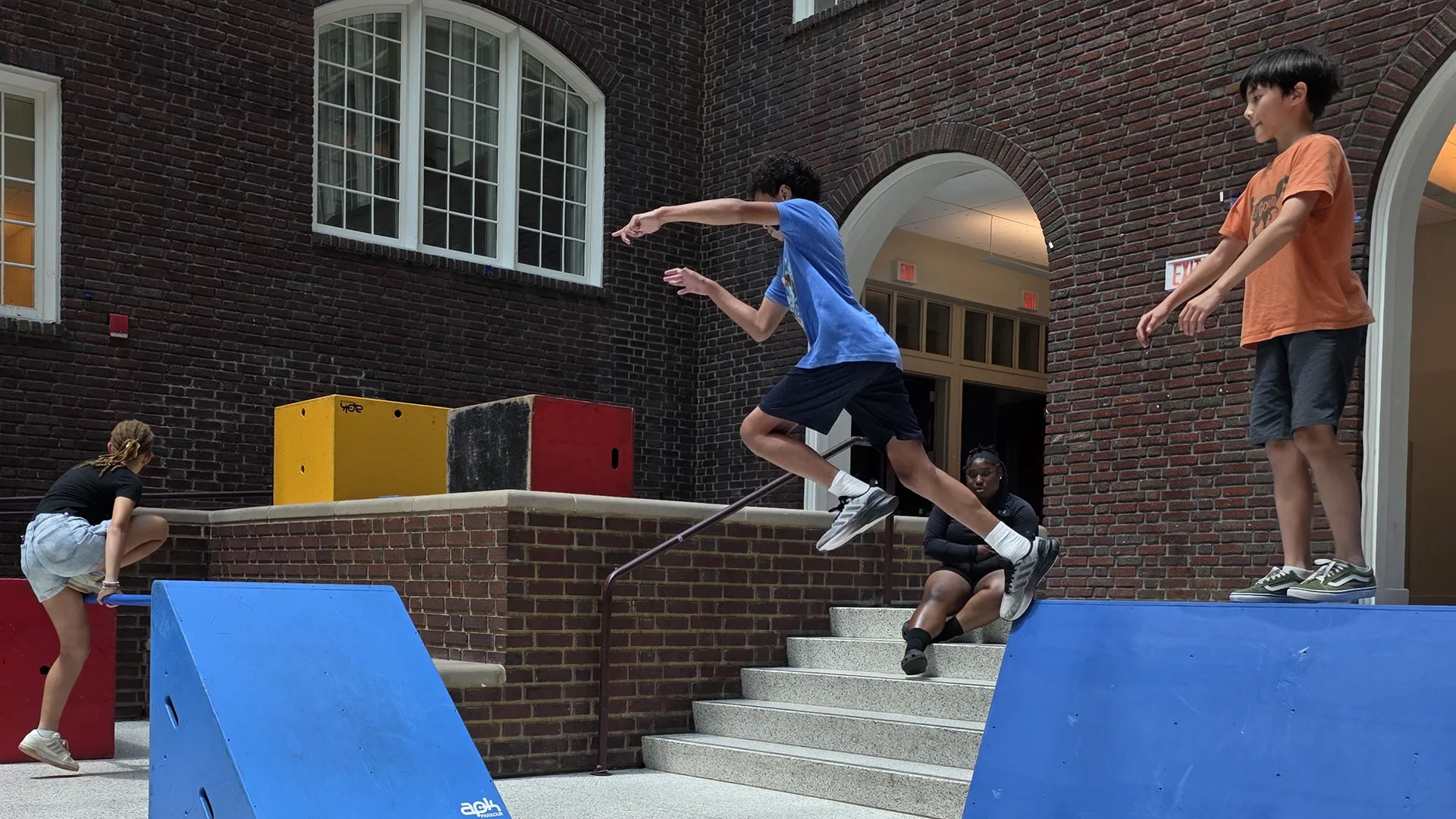
Why Parkour Elevates Physical Literacy in PE
Parkour accelerates physical literacy because it delivers dense, high-quality repetitions of fundamental patterns[1]– balance, precise foot placement, stable landings, and controlled deceleration – often without lines or idle time.
Progressions on APK equipment (Precision Sticks™, Zee Rail™, Lava Rocks™) make the environment predictable and scalable, so teachers can cue quiet feet, two-second still holds, and gentle, controlled touch-downs before adding height, speed, or distance[2]. That control-first sequence yields observable competence (students actually stick landings, track knees, and hit targets) and perceived competence (they feel capable early), which SHAPE America Standard 4 (2024) ties directly to choosing and valuing movement and Standard 1 (2024) connects to demonstrating varied motor skills.
Because obstacles can be adjusted for height, distance, and sequence in seconds, you get natural task variety without changing the learning goal – a key driver of adaptable motor patterns[1]. Classes stay inclusive: the same task scales for different abilities by adjusting target distance or rail height, not by splitting the class. Students also experience autonomy and creativity safely: there is more than one correct solution, but all solutions still demand control. The result is a room full of kids who are moving more, succeeding more often, and choosing to re-try — exactly what keeps them in PE and moving outside of class[3].
Bottom line: Parkour gives teachers a repeatable method to teach control before complexity on dedicated equipment, document progress quickly, and build the competence-confidence loop that sits at the heart of physical literacy.

Leave A Comment
You must be logged in to post a comment.