
From a strong Artistic Gymnastics tradition to its second World Championships appearance: 22 athletes, eight formations and a movement coming to Pesaro to learn, grow and show the world its own “spicy flavour”
By Silvana Conte
India is not coming to AcroPesaro 2026 simply to take part in a World Championships. It is coming to continue building a story that is still young — one born from the desire to expand a gymnastics tradition long focused primarily on Artistic Gymnastics and open it to new disciplines.
Pesaro will mark India’s second appearance at the Acrobatic Gymnastics World Championships, but the size of its delegation already reflects significant change. The country will be represented across the Youth, Junior and Senior categories by 22 athletes and eight formations, supported by coaches, team officials and judges.
Manohar Kamath, President of the Technical Committee for Acrobatic Gymnastics in India, explained the importance of bringing such a large delegation to Italy. The competition will offer India’s athletes new challenges and an opportunity to learn from some of the world’s most established Acrobatic Gymnastics programs.
For many years, Kamath explained, gymnastics in India was strongly oriented towards Artistic Gymnastics. More recently, the national movement has worked to develop Rhythmic, Aerobic, Trampoline and Acrobatic Gymnastics, gradually achieving stronger results and greater international representation.
India understands that it is still in a learning phase. But it is precisely this awareness that makes its participation so meaningful.
“We are here to learn from every performance and find out what we can do better. We are still in the learning stage, but at the same time, we have our own flavour — the ‘spicy flavour’ of India — which we will bring to our performances,” Kamath explained.
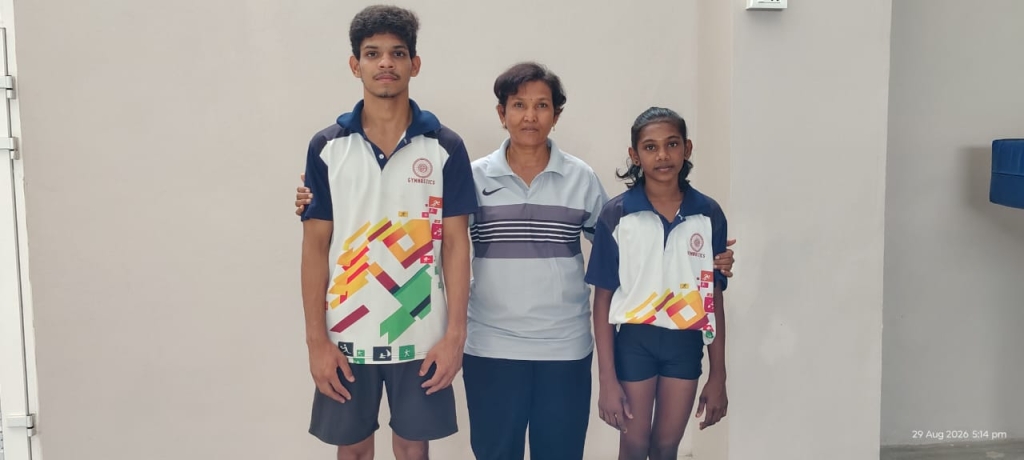
Coach: Dhanabagyam S B
Top: Ranjith Thamarai
Base: Kannan Kevin
Youth Men’s Pair – Ritesh Ravi Kumar and Shubham Bafna
For Ritesh Ravi Kumar, the base, and Shubham Bafna, the top, Pesaro will be their first competition outside India.
They have trained together for three years and have already participated in the Asian Championships in Goa. Although it was an international competition, it took place in their home country. Travelling to Italy will therefore mean experiencing a World Championships far from home for the first time.
Ritesh and Shubham both prefer dynamic exercises, but they are also attracted to the artistic side of Acrobatic Gymnastics: dance, elegance and the opportunity to combine strength with expression.
For Shubham, the courage required to perform the most difficult elements came from a simple decision: to try, keep trying and believe that he could succeed. Ritesh, meanwhile, takes pride in the responsibility of being a base and providing his partner with stability and safety.
Both described representing India as a source of great pride. When asked what they most wanted to try in Italy, their answer came immediately: pizza.
Youth Women’s Group – Sonika Gowda Bettaswamy Indrakumar, Rishya Kumaraswamy and Janvi Lokesh Gowda
The journey of Sonika Gowda Bettaswamy Indrakumar, Rishya Kumaraswamy and Janvi Lokesh Gowda began in Artistic Gymnastics and developed through a change in formation.
Sonika and Janvi had already competed together as a Women’s Pair at the Asian Championships. When their pair could not be entered for the World Championships, they began a new project as a Women’s Group with Rishya.
They had to transform different experiences into a shared identity. Sonika and Janvi brought what they had learned from their previous international experience, while Rishya embraced the opportunity to join the group as both a privilege and a new responsibility.
Sonika spoke with great clarity about the reality of Acrobatic Gymnastics in India. The movement is still growing, and competing against countries with well-established traditions shows how much work remains to be done. Watching the strongest formations helps them learn, even if it can also create nervousness.
In the demanding role of middle, Rishya puts her experience at the service of the structure. She is not simply the connection between the base and the top: she allows the pyramid to rise while maintaining control and stability without being in direct contact with the floor.
Janvi described the process of overcoming her initial fear. Repeating the elements gradually transformed uncertainty into confidence. During the most difficult moments, her teammates’ words become a point of reference: keep the body tight, believe in herself and visualise what she needs to perform.
This is how trust stops being an abstract concept and becomes a concrete action.
Junior Mixed Pair – Kannan Kavin and Ranjith Thamarai
Developed at the Erode Gymnastics Centre in Tamil Nadu, Kannan Kavin and Ranjith Thamarai have trained together for three years. Their daily preparation includes three hours in the morning and three hours in the evening.
Pesaro will be their first competition outside India.
Their identity is centred primarily on balance, the part of the program they both prefer. For Ranjith, the top, confidence comes from continuous learning, repetition and the trust developed through their daily work. For Kannan, stability and control are at the heart of his responsibility as a base.
Their coach, Dhanabagyam S. B., comes from Artistic Gymnastics, as do many of her athletes. She began experimenting with Acrobatic Gymnastics only three years ago, independently studying the Code of Points, the rules and the technical requirements of the discipline.
In just three years, that first experiment has taken two young athletes from her centre all the way to a World Championships.
For Dhanabagyam, accompanying them to Pesaro is tangible proof of how much a project can grow when curiosity, study and perseverance are transformed into daily work.
Junior Women’s Group – Laasya Pradeep Kumar, Pragna Shankar and Diya Mohan
Following their experience at the Asian Championships, Laasya Pradeep Kumar, Pragna Shankar and Diya Mohan clearly identified the areas they needed to improve: execution, element quality, dance and artistry.
Their strength comes from their ability to understand one another without always needing an explicit signal.
Laasya explained that their years together have taught them to recognise when each athlete is ready and when the group can attempt a difficult element. Communication and trust also allow them to understand one another’s emotions.
Pragna openly admitted that she often feels anxious before performing. To regain calm, the three athletes close their eyes, count, encourage one another and remind themselves that the routine lasts only a few minutes, while the years of preparation behind it deserve to be honoured.
Diya finds her greatest satisfaction in dynamic elements, particularly the double salto and turns. But her confidence comes from the behaviour of her bases: even when she makes a mistake or the structure falls, their first priority is to protect and catch her.
It is this certainty that gives a top the courage to climb again.
Junior Men’s Group – Shivateja Vasu Joshi, Poornachandra Tejaswi Manjunath, Madhava Anil Kumar and Siddh Bafna
Four athletes, four responsibilities and the need to react as one body.
For Shivateja Vasu Joshi, the experience gained at the Asian Championships became a promise to his teammates. Under pressure, his priority is not to disappoint them and to use his abilities to their full potential. During the most difficult moments, he focuses on his breathing and analyses what is happening.
Poornachandra Tejaswi Manjunath is preparing for his first international competition. Training with more experienced teammates has allowed him to observe and learn, but above all, to discover how much he enjoys working as part of a Men’s Group. His anticipation for Italy is accompanied by curiosity about everything he will experience for the first time.
For Madhava Anil Kumar, concentration is the decisive detail. Making his body strong and stable allows the athletes above him to maintain control and tension. He trains for two hours a day while working to balance gymnastics with his studies.
Siddh Bafna, the top of the group, has practised Acrobatic Gymnastics for four years and prefers dynamic elements. What excites him most is the adrenaline: climbing, performing the element and feeling that all the risk has been transformed into excitement.
Pesaro will be the first World Championships for all four athletes.
Senior Men’s Pair – Pravin Patil and Chinmai Gowda Lokesh
For Pravin Patil, Acrobatic Gymnastics is a combination of strength, flexibility, expression, synchronisation and partnership. But it is also a school for life because it teaches athletes to face challenges together.
Pravin has practised the discipline since 2007 and has directly experienced its evolution. In the past, attention was focused primarily on the difficulty of the elements. Today, music, choreography, expression and synchronisation have become essential parts of a complete performance.
After competing internationally as part of a Men’s Group, he has worked with Chinmai Gowda Lokesh, who comes from Artistic Gymnastics, as a pair for approximately two years.
Chinmai describes Acrobatic Gymnastics as a discipline that makes him feel strong and excited. He has also considered becoming a base and remains particularly attracted to the Men’s Group, but in the pair he has found a partnership that gives him confidence: Pravin supports him, makes him stronger and, as Chinmai explained, can almost read his mind.
Being selected from a country of more than one billion people to represent India at the Asian Championships and now at the World Championships is a source of enormous pride for them.
Senior Mixed Pair – Deepak Gupta and Aafia Jamal
Deepak Gupta and Aafia Jamal, from the Sector 7 Sports Complex in Chandigarh, have created a Mixed Pair in which balance, dance and expression play a central role.
Deepak came to Acrobatic Gymnastics after practising Artistic Gymnastics. What attracted him was the presence of dance and the opportunity to combine technical work with music and interpretation. The quality that impressed him most in Aafia is her expressiveness, especially during the routine’s most intense and melancholic moments.
Aafia describes Acrobatic Gymnastics as an exciting sport capable of creating powerful emotions. Her confidence comes primarily from one element: trust in her partner.
Her connection to gymnastics is also a family story. Her father, an Aerobic Gymnastics athlete, introduced her to the sport. He will not be able to attend the competition in Pesaro, but he will continue supporting her from home.
During their preparation, Aafia discovered a personal quality that she now recognises more confidently: her ability to remain focused and perform balance elements well.
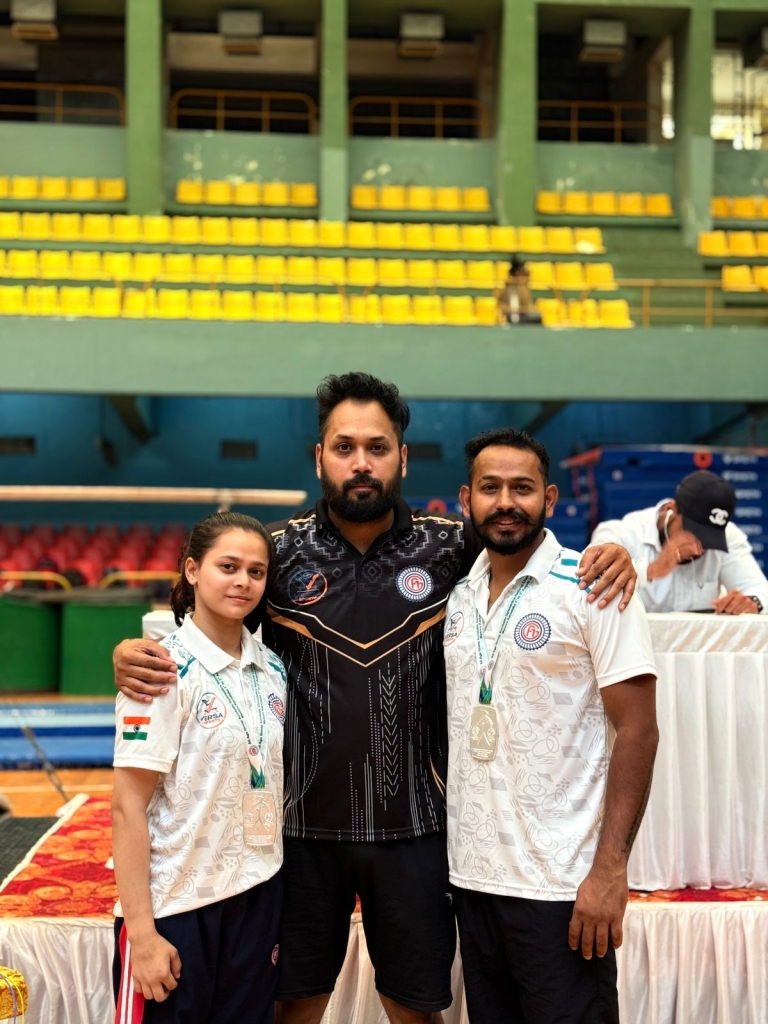
Senior coach: Devinder Singh
Mixed pair
Top: Aafia Jamal
Base: Deepak Gupta
Senior Men’s Group – Dinesh Singh, Neeraj Dwivedi, Bharat Khanna and Utkarshh Bokaria
The Senior Men’s Group brings together very different experiences and perfectly represents the transformation of Acrobatic Gymnastics in India.
Neeraj Dwivedi began his journey in the discipline in 2017 and won a silver medal at the 2023 Asian Championships with a different formation. That result fulfilled one of his first major international dreams. He now brings that experience to a new group, fully aware of the work required to reach the world stage.
Dinesh Singh entered Acrobatic Gymnastics only one year ago after a career in Aerobic Gymnastics. In the new group, he performs as the first base, the position upon which the entire structure is built. His teammates immediately recognised the physical strength he could bring to this responsibility. For Dinesh, changing disciplines and reaching the World Championships so quickly is an opportunity he approaches with gratitude and enthusiasm.
In the third position, Bharat Khanna is an essential connection point. He must coordinate with the top while simultaneously working with the athletes below him. This role requires attention, precision and a great deal of work. When asked which lesson from Acrobatic Gymnastics he carries into everyday life, his answer was immediate: discipline.
At the top of the structure is Utkarshh Bokaria, who has practised Acrobatic Gymnastics for four years. For him, climbing to the group’s highest point creates an extraordinary feeling. He prefers dynamic elements and turns, while he considers holding individual positions one of his greatest challenges: those three seconds of balance can feel much longer to a top.
For all four athletes, competing abroad and representing India on the world stage is the fulfilment of a sporting dream.
The People Building the Movement
Behind these eight formations is a young system learning to develop not only athletes but also coaches and judges.
Youth and Junior coach Pranav Simha Turuvekere explained that he was attracted to Acrobatic Gymnastics because the discipline brings together two dimensions that he considers inseparable: artistic creativity and technical difficulty.
“Acrobatic Gymnastics has always fascinated me because it combines artistry and elements — the creative side of the sport with the difficulty performed by the gymnasts. That is why I enjoy both practising and coaching Acro,” he explained.
Pranav works with numerous formations and categories, but he also highlights the athletes’ own creative contribution: “Our gymnasts are really good at choreography. We do not have to work too hard on it because it comes naturally to them.”
A particularly important step for the country was the recent international judging course held in Goa.
“Many coaches and judges learned more about Acrobatic Gymnastics through that course. Since then, we have seen significant improvement among gymnasts across India, and the competitions have reached a higher level compared with last year,” Pranav said.
Alongside Pranav and Dhanabagyam S. B., the delegation is supported by Veena Thirumale Srinivasa Murthy, Team Manager for the Youth and Junior team and Senior coach, and Davinder Singh, Senior coach.
Judges also play a fundamental role in this growth. India will be represented in Pesaro by Viralkumar Navneetlal Patel, Prachi Parkhi and Avijit Debnath.
Having judges working across different competition categories, alongside the development of athletes and coaches, demonstrates that India is building a complete system for the growth of Acrobatic Gymnastics.
A Generation That Is Not Inheriting the Road — It Is Building It
Many of the athletes travelling to Pesaro have never competed outside India. Some have practised Acrobatic Gymnastics for only a few years. Others have changed disciplines, formations or roles. Almost all of them will be competing at their first World Championships.
They will not arrive claiming to be at the same level as the world’s most established programs. They will arrive ready to observe, learn, compete and show what they are building.
And that is precisely what makes their presence so important.
These athletes are not simply following an established path: they are the generation creating it. Their names will remain connected to the years in which Indian Acrobatic Gymnastics began looking towards the world with greater ambition and confidence.
In Pesaro, they will bring strength, curiosity, national pride and the distinctive “spicy flavour” that Manohar Kamath used to describe the identity of Team India.
Their AcroDream is not simply about a result. It is about watching a movement grow, formation by formation, until it earns its place on the international stage.
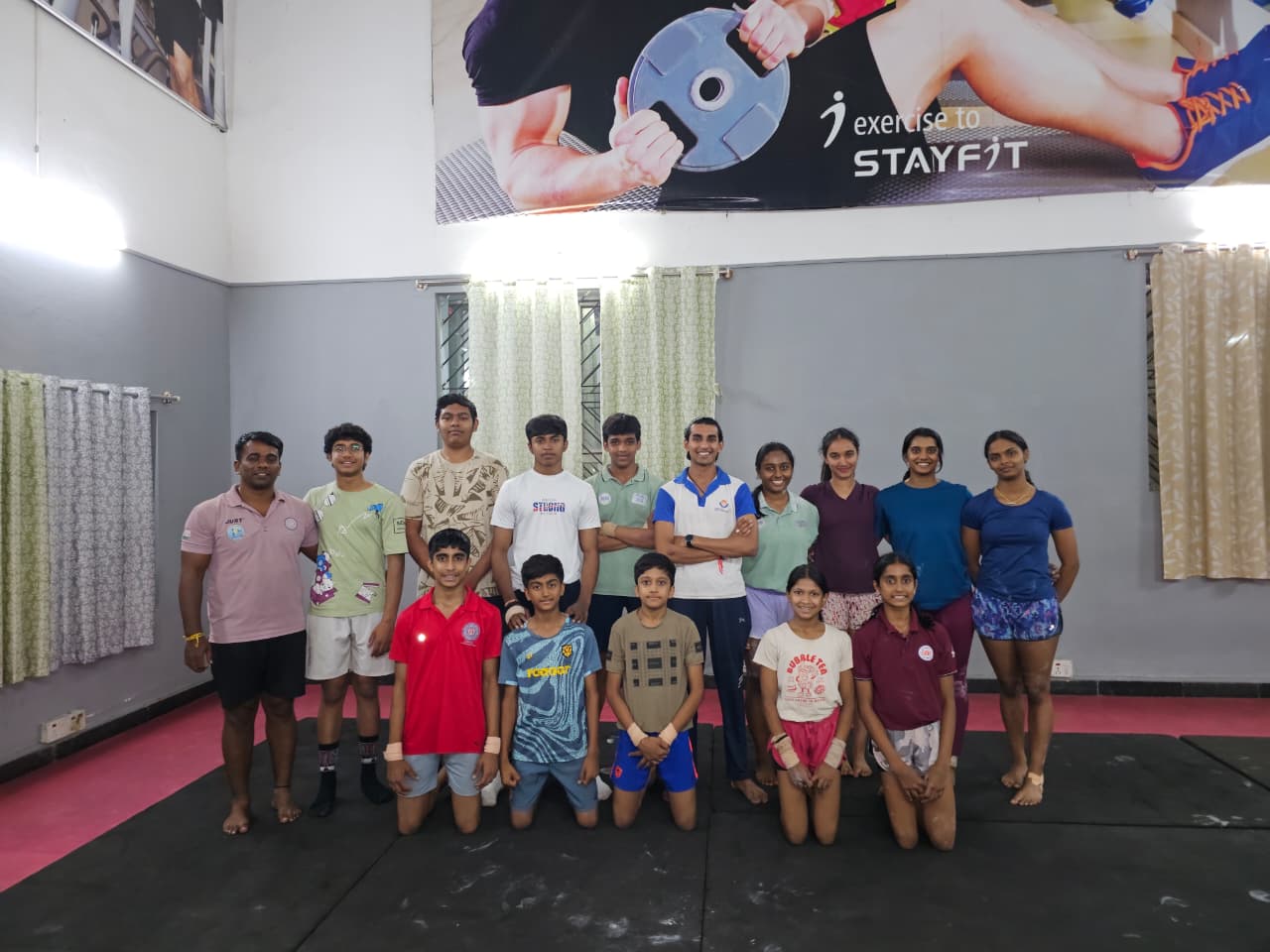
Coach: Pranav Simha Turuvekere
Youth
Men’s pair
Top: Shubham Bafna
Base: Ritesh Ravi Kumar
Women’s Group
Top: Janvi Lokesh Gowda
Base2: Rishya Kumaraswamy
Base 1: Sonika Gowda Bettaswamy Indrakumar
Junior
Women’s Group
Top: Diya Mohan
Base 2: Pragna Shankar
Base 1: Laasya Pradeep Kumar
Men’s Group
Top: Sidh Bafna
Base 3: Madhava Anil
Base 2: Poornachandra Tejaswi Manjunath
Base 1: Shivateja Vasu Joshi
ACROPESARO 2026 — USEFUL INFORMATION
Youth & Junior World Championships
17–20 September 2026
Senior World Championships
24–27 September 2026
Venue: Vitrifrigo Arena — Pesaro, Italy
Tickets: Available exclusively online through Vivaticket. There will be no physical ticket office at the Arena.
Hotel and ticket packages: Available through Esatour.
Official website: www.acropesaro2026.com
Instagram and Facebook: @acropesaro2026


Leave A Comment
You must be logged in to post a comment.