
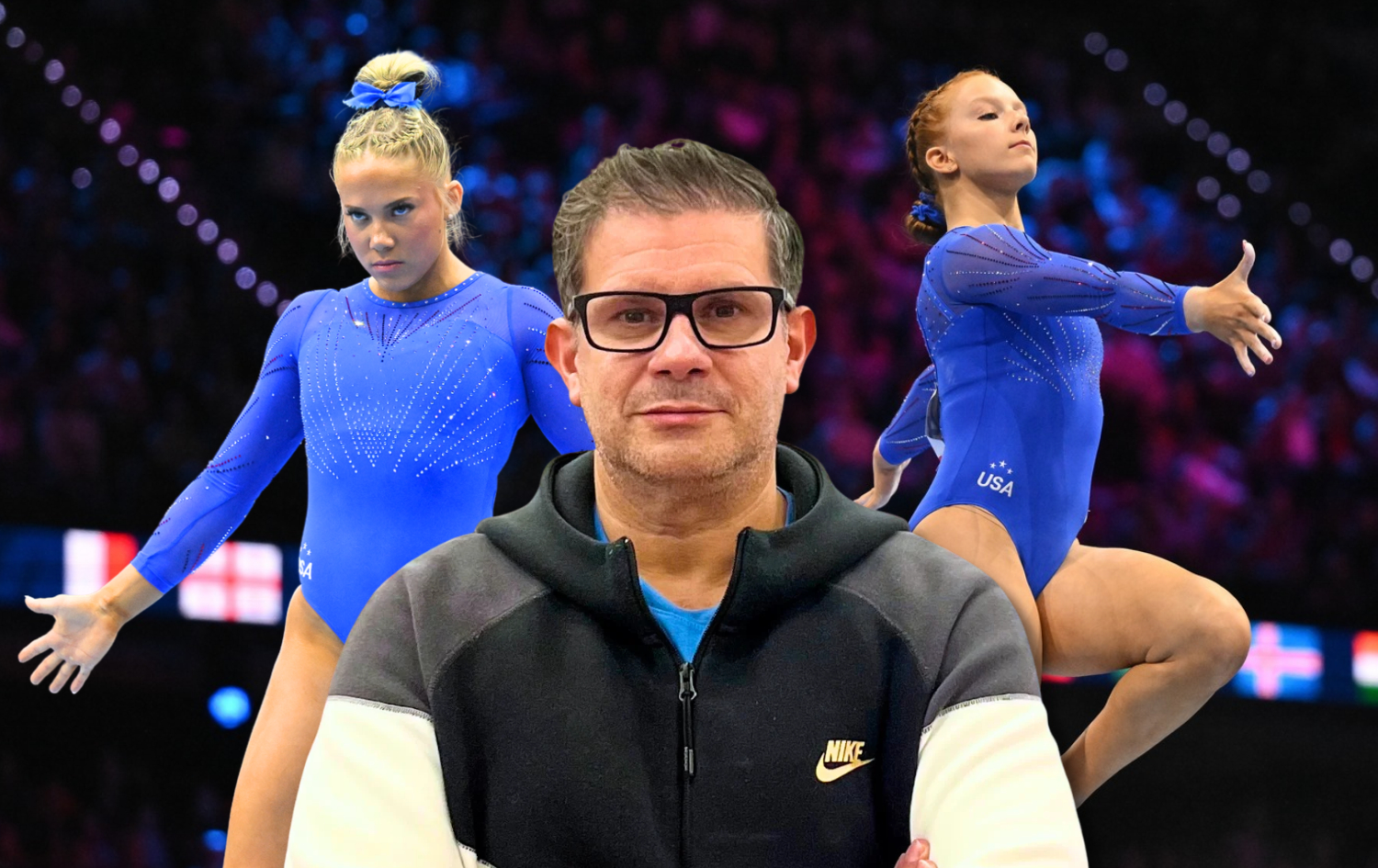
After the U.S. women completed qualifying at the 2026 World Artistic Gymnastics Championships, U.S. and World Champions Centre coach Patrick Kiens met with the media to discuss the performance, AI judging, Dulcy Caylor’s call up after Hezly Rivera’s injury, and Reese Esponda having to change one of her passes just days before competition.
Assessing the U.S. women’s performance in qualifying
Question: How did you feel today?
Patrick Kiens: Excited. The girls did the work, so we were happy. The training went quite smooth, so no big hiccups for the athletes that Daymon [Jones] and I train from WCC, and overall I think the whole team did really well. Of course, we had the injury with Hezly, which is very unfortunate, but I think the team spirit is very good. The girls work very hard; they hit their routines, and I think that showed out there that they hit four out of four on each event.
Q: Some gymnasts today have had their vaults downgraded by the Fujitsu AI Judging Support System. Did you guys have any surprises with Fujitsu today, or were things as expected?
Kiens: So they did not judge the AI on floor dance elements, so we got the start values. I think vault, we got everything. Bars we got everything. I think beam, we did not get everything with the beam routine from Claire. But with the naked eye, you could also see that some connections were not through, and that was also with Dulcy the case. That you think, ‘oh, that’s a question mark. Oh, that ring is a question mark.’ Then if they look back on AI, I think AI doesn’t lie. AI doesn’t lie.
On Reese Esponda’s last minute floor pass change
Q: World Gymnastics deciding Reese’s Barani to double back didn’t count as a forward element. Was that a big deal for her to have to switch passes just a few days before competing here?
Kiens: Well, we chose a pass that she has competed when she was a junior, so it wasn’t difficult for Reese to switch to that element. Where I have a problem with is that the judging and the interpretation of the technical rules are not consistent. If you competed in an FIG-sanctioned competition and Donatella [Sacchi] – the head of the FIG is the supervisor there – and there is no problem with the element and it looks exactly the same as how she performs it here, that means that you look with different eyes over there than you look here while it’s both an FIG-sanctioned competition. That should not happen.
Q: Have you gotten any explanation yet for why that was the case? (Esponda competed at Jesolo Trophy earlier this season, winning floor exercise. Sacchi was in attendance at the meet.)
Kiens: Well, the only thing what I heard through [U.S. high performance technical lead Chellsie [Memmel] is that Donatella said it wasn’t pointed out to her during that competition, and my idea is how can you have missed it because she won the floor final? But they make the rules, not me, and we just have to live by it.
Q: Has Reese had a positive reaction in how she responded?
Kiens: Oh yeah, absolutely. You cannot blame anything on Reese. Reese did her job, and also here she did her job. And okay, she had like a little part of the heel outside of the floor, so there’s a little bit room for more. I don’t know. We need to see what’s going to happen now – if she’s going to make final and where she’s at. That you only know after 10 subdivisions.
Discussing Dulcy Caylor’s call up to the main team
Q: Dulcy looked so confident out there. What kind of talks did you have with her?
Kiens: I think it’s more the credits of Daymon. Daymon and Dulcy connect really well together, and Daymon is the beam coach in our gym, mainly. Although we both coach all-around, the big chunk of the beam training is for Daymon’s account, and I think now we are almost two years at WCC, so it starts to really show that she’s a beamer.
Q: How much of a mindset shift did Dulcy have to go through from finding out that she was going to be competing?
Kiens: So Daymon and I did, I think, nine world championships and three Olympic Games, and we told Dulcy from the start: be aware, the chance that you compete is quite high. So she just kept doing her routines like everybody else, as if she was going to compete. And I think also that is the role of an alternate position. You need to approach it as if you are going to compete because it can happen. It has happened before. It will happen in the future, and it happened today.
This interview has been lightly edited for length and clarity.


Leave A Comment
You must be logged in to post a comment.