
With the 2026 World Artistic Gymnastics Championships in Rotterdam less than a week away, the competition is officially starting to heat up. As the nominative roster becomes official and gymnasts start to make their way to the Netherlands, we are starting to get a clearer picture of who may be in contention for both finals and medals.
While we have gotten used to American dominance in the women’s team event over the last decade and a half, the tide may be changing. The last time Worlds was held in Rotterdam – 2010 – was the most recent world championships to feature a team final winner other than the United States (Russia).
Many teams will be heading into the competition with hopes of outperforming the expectations of yesteryear, and plenty have the talent to back up their goals. We are making our way through the women’s teams most poised to make the team final in order to give you a sense of the stakes heading into the first Los Angeles 2028 Olympic Qualifier. This preview covers the Americas.
As a reminder, the top three teams in this year’s team final will earn tickets to LA, with nine more teams to be named at next year’s championship.
United States
The Team
After relying largely on the same group of veteran gymnasts for the past couple of quads, the tide seems to shifting in USA Gymnastics. For the first time at a non-individual Worlds since 2018, the United States is sending three world newcomers to defend its 15-year-long team final winning streak.
The U.S. team is one of the most compelling of the competition on paper, but the rest of the world is catching up, meaning a team gold medal may not come as easily as in years past. With Simone Biles, Jordan Chiles, Shilese Jones, and Suni Lee all in various stages of limbo, the onus is on the new generation to prove that the federation is in good hands for years to come.
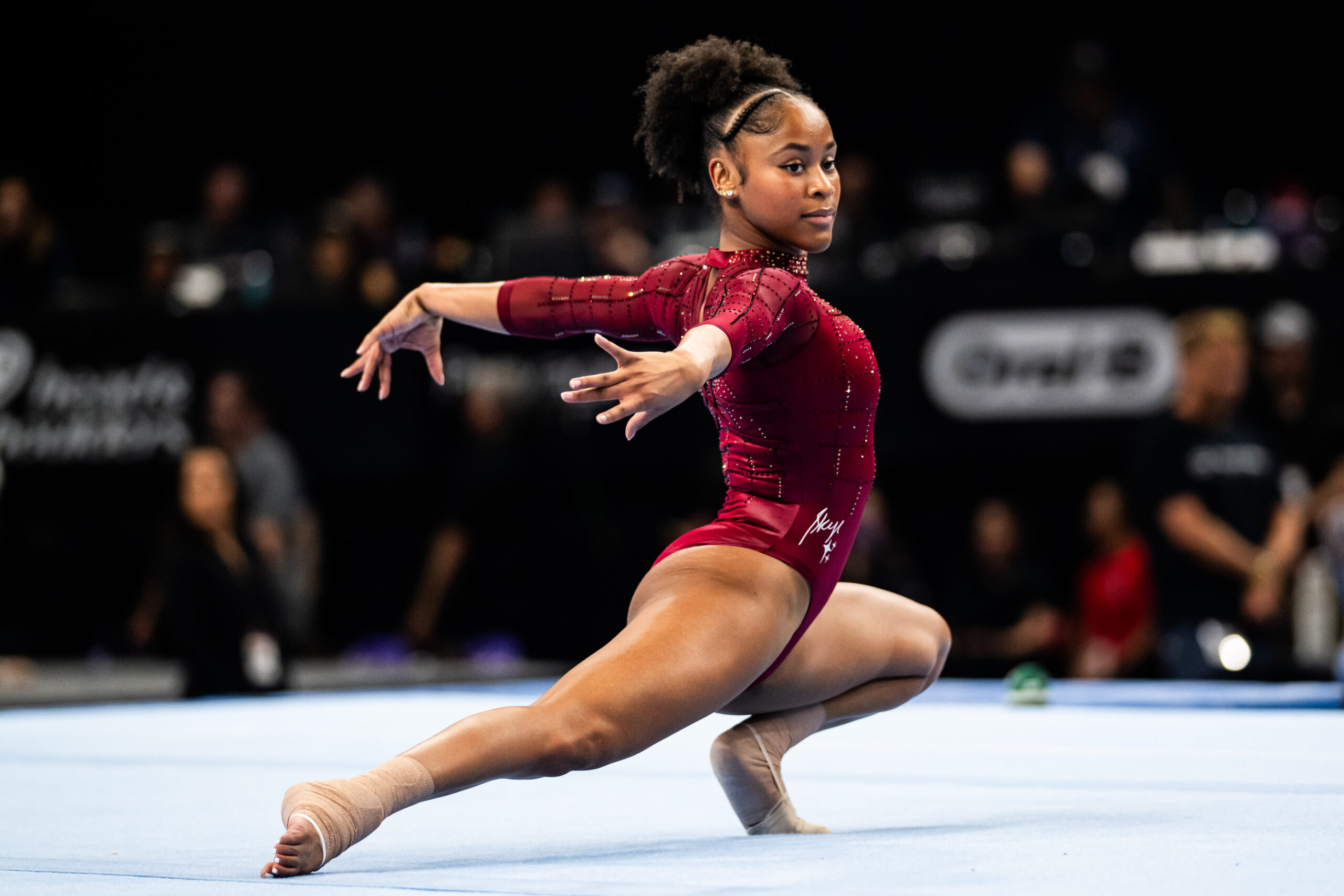
Skye Blakely is the veteran of the team, earning her fourth Worlds assignment on the back of her best all-around performance of the season at world selection camp. She’ll be joined by Claire Pease, Charleigh Bullock, and Reese Esponda. 2024 Olympic Champion Hezly Rivera was originally slated to compete in Rotterdam, but she pulled out the day before qualifying with a left ankle injury. 2025 world team member Dulcy Caylor will replace Rivera.
The Breakdown
Vault was looking like a solid – if not particularly outstanding by the standards of the last few quads – rotation for the U.S. prior to selection camp, but some recent upgrades serve to change the potential event final landscape. Pease debuted and subsequently stuck a Cheng vault, which, along with her double-twisting Yurchenko, is likely to make up the most difficult combination of vaults competed at this year’s championship. Esponda has a double-twisting Yurchenko and has debuted a solid Lopez, but the latter was absent in podium training.
Blakely – who competes the same vaults as Esponda – is likely to make the event final with Pease, coming within a tenth of the selection camp vault title despite starting 0.8 lower than Pease in difficulty. Bullock and Caylor both offer solid DTYs that could fill out the lineup, but Rivera’s absence means Bullock is most likely to take her place in the lineup to secure an all-around berth.
Bars has the potential to be a strength for the U.S., but nearly every necessary contributor has struggled with consistency at some point this year. Blakely is the exception, hitting every routine so far this season for at least a 14.100. Pease has plenty of bars potential, but she has failed to put together complete routines in pressure situations, missing in the Pan Ams event final. Bullock has been an asset for the U.S. on bars, boasting stunning extension and a natural swing. She does have a miss for 13.200 on her record, but otherwise she has been rock solid, hitting the 14 mark an impressive 10 times this season.
Though Rivera struggled mightily with bars consistency throughout the season, falling in three of her last four routines, the event may still be where her absence is felt hardest on potential alone. Both Caylor and Esponda have scored in the mid-13s for most of the season, though Esponda has been rapidly improving and matched her career high with a 13.700 at selection. It is not quite the 14+ score that Rivera could deliver with a hit, but it will have to do in a pinch.
Beam is likely to feature a similar lineup to bars, with Blakely, Pease, and Bullock seemingly being lineup locks. Beam should be Blakely’s best event, and has often been the calling card that has earned her major assignments, but she has had major mistakes in each of her three Worlds appearances and is yet to make a podium.
Pease’s fluidity and extension, particularly on her Onodi mixed series, makes her one to watch, and someone who could potentially factor into the event final picture with a nice routine in qualifications. Bullock’s scores have not quite matched the peaks of Blakely or Pease, but she has been on a roll lately, going four-for-four on hits across the U.S. Championships and selection camp.
As with bars, the final lineup spot comes down to Esponda or Caylor. Caylor made the event final in 2025, but she has generally scored lower than Esponda throughout the year.
As has come to be the expectation in recent years, floor looks to be one of, if not the, strongest events for the United States. Esponda may just be the gold medal favorite, despite a last-minute shakeup in her routine composition caused by World Gymnastics’ decision not to count her Barani as a forward skill. Even without her trademark pass – Barani to double tuck – Esponda is still looking at a 6.0 D-score, especially if she adds the layout stepout after her double tuck that she has shown in training.
Pease’s floor scores have been subject to debate among the gymnastics community, but it is hard to deny her difficulty – 6.1. She could challenge for the event final with a hit, even if she were to wisely choose not to perform her uber-difficult Moors in qualifying.
Floor has been a mixed bag for Blakely since bringing the event back after a two-year hiatus, but her gaudy domestic all-around scores are hard to ignore, especially considering her event final potential on the other three events.
Bullock is the most likely option for the last floor lineup spot with Rivera out, though Caylor also made the event final at Worlds last year. Another potential option if USAG wants to give one of its stars a bit of rest is to sub Caylor into the floor rotation in the team final, but with Rivera out, the United States may not have room for a less-than-optimal lineup without potentially sacrificing the gold medal.
Brazil
The Team
Alert the town crier, Rebeca Andrade is back! The nine-time world medalist is making her return to major international competition for the first time since a four-medal performance at the Paris Olympics. Though she is only competing vault and beam this year, any opportunity to see Andrade compete is a win for gymnastics fans worldwide.
She will be joined by longtime teammate Flavia Saraiva, along with Lorrane Oliveira and Thais Fidelis, who were both mainstays of the Brazilian squad throughout the Tokyo and Paris quads. 2025 world team member Sophia Weisberg and Gabriela Boucas were also both named to the team, with an alternate to be officially selected at a later date.
Boucas was originally in the driver’s seat for a competition spot, but recent upgrades from Weisberg, particularly on vault, have changed the picture significantly.
Though this squad is quite different from years past – veteran Jade Barbosa recently had a baby, and three-time Worlds competitor Julia Soares has competed sparingly in 2026 – Brazil will still be aiming to make the team podium after winning medals at both 2023 Worlds and the 2024 Olympics. The path does look noticeably harder, especially with how good China and Japan have looked this year, but it would be remiss to fully count out a team led by Andrade and Saraiva.
The Breakdown
Andrade has not competed her beautiful Cheng vault this year, but she may still be the gold medal favorite on execution alone. After winning world titles in 2021 and 2023, the 27-year-old is one title away from tying Cheng Fei for the most world vault wins. She won the Pan Ams vault title over Lia-Monica Fontaine by a small margin, but there was definitely room to improve on her Lopez second vault, which incurred a 0.1 out of bounds penalty in the final.
Saraiva also seems to not be at full strength on vault, having not competed her DTY yet this year, but even her downgraded vault was enough to win the Brazilian national all-around title, meaning she is likely to factor into the lineup regardless of what she is competing. Fidelis only has a full-twisting Yurchenko, but she really locked in at Pan Ams, outscoring multiple gymnasts competing harder vaults in both qualifications and the all-around final.
Boucas would have likely been the top choice for the final lineup spot, also having a clean FTY that scored well at Pan Ams, but Weisburg has upped the ante in the last week, showing a solid DTY to competition height in training. If that vault materializes, Weisberg’s team stock goes way up, potentially even earning back the all-around nod she got at Pan Ams, where she placed fourth.
Since Andrade is skipping bars this year, the other four team members will have to pick up the slack. Both Saraiva and Oliveira had promising showings at the Szombathely Challenge Cup in September, with Saraiva taking home bars gold and Oliveira scoring an impressive 14.066 in qualifications. If Oliveira can recreate that kind of number in Rotterdam, Brazil should be in a much more solid position.
Weisberg is realistically the next best Brazilian bars worker, winning the bronze medal at Pan Ams. Though Boucas could also be a lineup option if necessary, bars looks like another area where Weisberg pulls ahead in the race for the final team spot. Fidelis is not a particularly strong bars worker, but her all-around contributions along with Andrade’s absence make her a shoo-in for the final lineup spot, at least in qualifications.
Any beam lineup featuring Saraiva is one to watch as she continues to hunt for her first major international beam medal in her seventh appearance at Worlds. She has looked great this year, but as is seemingly always the case, it will come down to hitting her best routines in critical moments. Andrade has only competed two beam routines this year, but she already has a season high of 14.100 and will be looking to return to the final after winning bronze at her last Worlds appearance in 2023. Fidelis has also scored well this year, adding to her all-around resume.
The uncertainty of the beam rotation presents Boucas’ best shot of making the main squad, putting up solid numbers en route to the South American Games beam title. She is realistically a better, or at least higher scoring, beam worker than Weisberg or Oliveira, though it remains unclear if she contributes enough elsewhere to make it out of the alternate ranks. In the event that she does not make the team, expect Weisberg to fill in the final beam lineup spot to help secure an all-around score.
Though having the reigning Olympic champion sitting out floor this season hurts Brazil’s overall score potential, the federation still has plenty of reason to believe that floor can be one of its most competitive events.
Saraiva’s trademark toe point will be on full display, paired with more dramatic and suspenseful choreography compared to routines of years past. Oliveira is channeling her inner Brazilian gymnastics legend Daiane dos Santos, competing a breathtaking whip to piked double Arabian. Though her scores this year have not been the highest, mostly due to some form issues on dance elements, she still is likely to factor into the lineup.
Even with Fidelis long since retiring her own Arabian combo – one and a half through to double Arabian – she did make the Pan Ams event final and is likely to make the cut for a Worlds qualification spot as well.
Once again, with Andrade announcing her retirement from floor all together, the last spot will come down to whichever of Weisberg or Boucas makes the team. They have scored fairly similarly this season, though Boucas may have a slight edge here after a solid showing at the South American Games. Unfortunately, any benefit that Boucas brings with her beautifully choreographed routine is unlikely to match the scoring boost provided by Weisberg’s potential DTY.
Canada
The Team
Four-time Olympian Ellie Black is back with a vengeance, returning to the all-around in early 2026 for the first time since the Paris Olympics. It did not take long for her to regain her world-class status, winning the Commonwealth Games all-around title less than three months after her initial comeback.
While Black was making her way back, Canada’s new star – Lia-Monica Fontaine – has established herself as an all-around threat. She is also delivering Canada’s best vaults since Black was a bona fide specialist in her early years. The pair will be joined by 2025 world team member Gabrielle Black, along with newcomers Lia Redick and Coralie Demers.
Canada’s path to the team final is less straightforward than a lot of the other teams competing in Rotterdam, but the combination of a healthy Ellie Black and Fontaine, who looks to be even better now than in her senior debut season last year, is a solid foundation to build on. Even if the team final ends up being a miss, Black and Fontaine still may play into the individual medal standings.
The Breakdown
After being the rotation partially responsible for missing the world team final in 2023, Canada has retooled its vault squad around Fontaine, the defending world silver medalist. She looks ready to reach the podium again, boasting a well-executed double-twisting Yurchenko and Lopez combo. Though Ellie Black has not competed two vaults yet this year, her Tsuk 1.5 has scored well and is likely to make its way into the qualifications lineup. Gabrielle Black does compete two vaults, with her double-twisting Yurchenko being a highlight. She has routinely averaged around the mid-13s and could be a dark horse for the final should things go her way. Demers has not vaulted at all in her first year as a senior elite, meaning that Redick’s powerful Yurchenko 1.5 (a future addition to the LSU lineup) will be Canada’s fourth routine up in qualifications.
It is worth mentioning that Gabrielle Black did not vault at the Commonwealth Games in late July, but that team also included Alyssa Guerrier Calixte, who is a solid vaulter in her own right.
Bars has been a rough spot for Canada in the past, with both difficulty and execution sliding behind the pack at times. Demers’ inclusion on the team should help alleviate some bars-related anxiety – if her 13.900 gold medal-winning Canadian Championships score can materialize in an international context. Bars is probably the worst event for both Ellie Black and Fontaine, but both have the potential to bring in solid scores. Black in particular really hit her stride at Commonwealth Games, scoring above a 13.850 twice. She’s also bringing an upgraded dismount – a toe-on tuck 1.5.
Both Redick and Gabrielle Black have struggled on bars this year, with only one 13+ score between the pair, meaning the decision of the fourth lineup spot will come down to who Canada wants to join Ellie Black and Fontaine in competing in the all-around. Redick got the nod at both Pan Ams and Commonwealth Games, but Black’s DTY may help boost her scoring potential.
Beam was one of two events that Ellie Black competed at Worlds last year, and it was the only one where she made the final. Though she does not have the difficulty to match the world’s top beam workers from China and Japan, her execution and consistency make her a great spoiler in a chaotic final.
Once again, Demers has not competed beam this year, meaning the last two lineup spots should go to Fontaine and Gabrielle Black by default. Black is the reigning Canadian champion, but she has yet to come remotely close to that 13.700 benchmark in any other competition. Redick has also struggled to score consistently throughout the season, but she has maxed out in a similar range around the mid-to-high 13s.
Though beam is a formidable obstacle for Canada, it also serves to be a big opportunity if everyone is on at the same time. Especially considering that Canada is in a later subdivision and will know roughly what it needs to challenge for a team final spot, a hit rotation may be the difference maker in returning for the first time since winning a surprise bronze medal in 2022.
Floor projects to be a solid rotation, though Ellie Black is still not competing full difficulty – downgrading both her front full to triple twist (second salto replaced with a double tuck) and two-and-a-half to double tuck (second salto replaced with a double twist). In her absence, Redick and Fontaine have both stepped up, making the floor final at Commonwealth Games. Fontaine has upgraded since winning the Pan Ams gold medal last year, adding a double layout to her routine. Redick has been on a similar hot streak, performing well across numerous international assignments this year.
Gabrielle Black is the reigning national floor silver medalist and should take the fourth spot in qualifications over Demers, who has only competed the event a handful of times this season to mixed results.

Leave A Comment
You must be logged in to post a comment.