
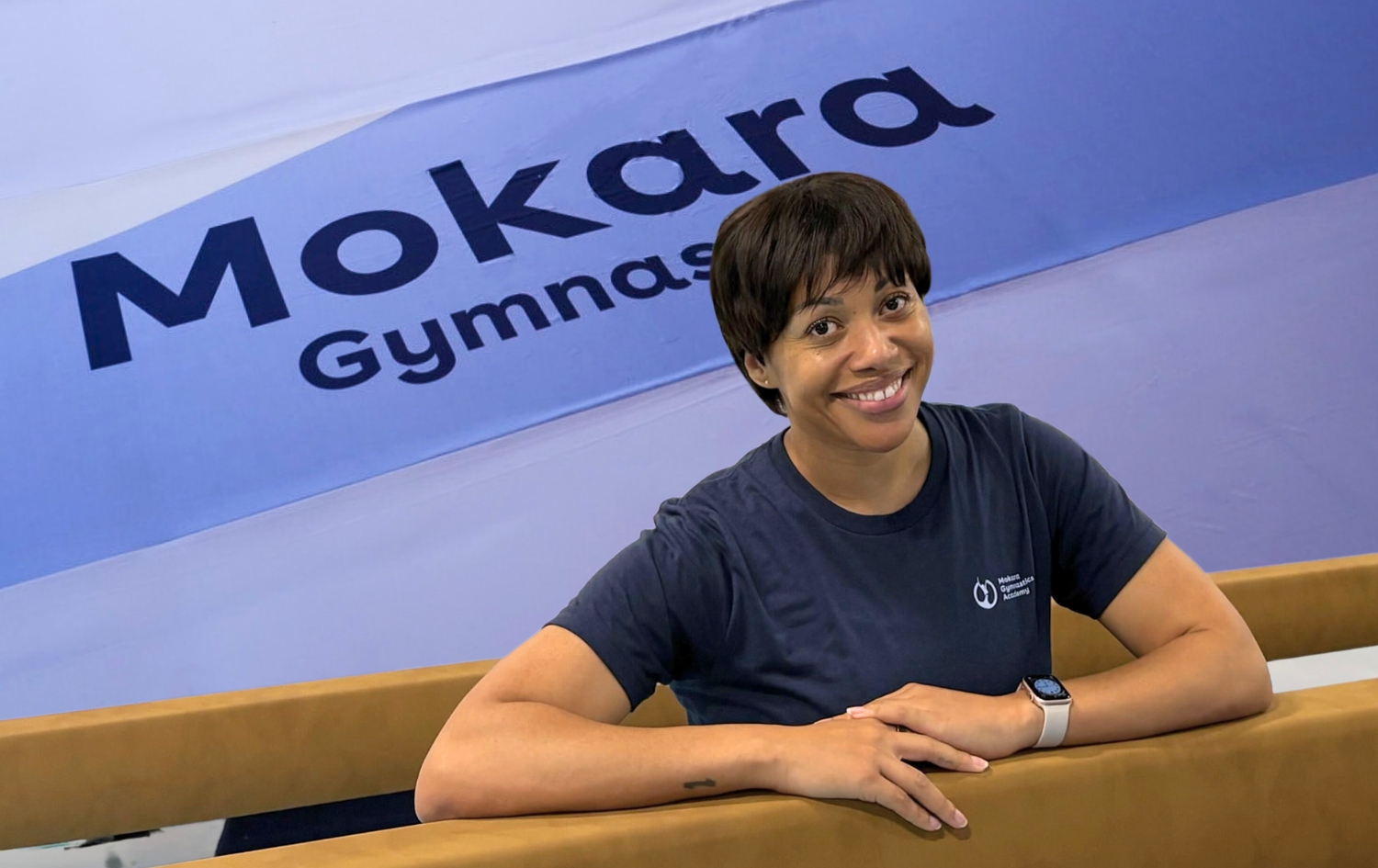
Photo of Cleo Washington courtesy of Mokara Gymnastics Academy in Singapore.
The former U.S. elite coach behind several top American gymnasts is bringing her experience overseas to lead a new facility aimed at helping grow Singapore and Southeast Asia’s rapidly emerging gymnastics scene.
This article is sponsored by Mokara Gymnastics Academy Singapore as part of a paid partnership. The Gymnastics Now editorial team maintains full control over the reporting and writing of sponsored features. Learn more about Mokara Gymnastics Academy Singapore here.
Singapore gymnastics achieved a major milestone last year when the country produced its first world finalist, signaling a turning point for the sport in the region. Now, former U.S. elite coach Cleo Washington has been tapped to lead the launch of a new gymnastics facility in the Southeast Asian country.
Mokara Gymnastics Academy was founded on the belief that there is immense potential in Asian gymnastics. The leadership team, consisting of Washington, co-founder and gymnast Riley Lee, and Recreational Programme Director David Ward, seeks to not only create the largest gymnastics club in Singapore, but also one that fosters a love for the sport, no matter a gymnast’s age or level.
Why Cleo Washington decided to make the move to Singapore
Washington has been a staple on the U.S. gymnastics scene for more than two decades, coaching at First State in Delaware and, most recently, Airborne in California.

Just last August, Washington was at the U.S. championships with Nola Matthews. Prior to Matthews, she coached 2017 world all-around champion Morgan Hurd. Not to mention the numerous other athletes she has guided to collegiate scholarships.
With the U.S. being a powerhouse in the sport of gymnastics, most coaches find a gym, plant roots, and rise the ranks, developing a reputation that draws world class talent to their club. Washington had done that.
When she first met Mokara co-founders and father-daughter duo Riley and Roger Lee, she didn’t entertain the idea of moving across the world; Washington was happy at Airborne and was (and still is) close with many of her co-workers.
But Riley and Roger checked in from time to time, and Washington’s adventurous side – the part of her that likes to do things that are hard and challenge her – started to creep in. Then, after the Mokara team flew her out to Singapore, Roger asked a pivotal question: ‘If you stay at Airborne – which you love – five years from now, what would be different?’
Washington didn’t like her answer – ‘Honestly, not much.’
“I like learning and growing and stretching and getting outside of my comfort zone,” Washington said. “It just made sense… Our values were aligned, and it’s that we create really high level, exceptional, world class gymnastics, but at the same time, take care of athletes holistically – so physically, emotionally, and psychologically.”
It was settled. Washington packed up and moved to Singapore in November, shortly after Matthews moved to Los Angeles to join the UCLA gymnastics team.
“There’s never a right time to leave your athletes, but if ever there was a right time, it felt like that.”
Perfect timing: Singapore’s gymnastics moment
Just weeks before Washington moved, Singapore achieved a milestone moment in gymnastics as Amanda Yap became the country’s first world finalist when she made the beam final at the 2025 World Artistic Gymnastics Championships.
Now, Washington will meet locals who have nothing to do with gymnastics, and when she tells them she’s a gymnastics coach, they’ll bring up Yap’s performance at Worlds.

“It kind of put gymnastics on the map,” Washington said. “I think it gives the young athletes here a sense of belief that it can be done. It’s so different, like seeing it on TV and kind of wishing and hoping or aspiring to be something, but to kind of see it in your own backyard, it absolutely is motivating for these athletes.”
Washington believes there are hundreds and hundreds of kids like Matthews or Hurd in Southeast Asia right now. The key to developing elite gymnasts to be their best is identifying the athletes who not only love gymnastics – “Morgan and Nola both LOVED gymnastics; they were gymnastics fans.” – but also have the grit and resilience to not be deterred when they fail.
“If an athlete isn’t resilient, if an athlete doesn’t have the right mindset, it doesn’t matter,” Washington said. “There are a lot of talented athletes here in Singapore, but I think what we’re most interested in is the personality and the mental part – the mental aspect that goes behind it. I think that is what’s going to create champions, as opposed to just raw talent.”
There are athletes in Singapore with that talent, resilience, and passion; they exist all over the world. But there are still barriers keeping those athletes from reaching their highest potential.
Washington says there are three barriers to success she has identified in her short time in Singapore: a lack of elite facilities, coaching expertise, and the old school coaching mentality.
When it comes to the facilities, real estate is hard to come by. Everything builds up because the country is small. Singapore is roughly half the size of Rhode Island and more comparable to the size of New York City. Digging deep enough pits? Not possible. Creating a safe environment for athletes to train is challenging.
When it comes to coaching, it’s difficult to find good coaches (just like it’s hard to find them anywhere). It’s especially difficult to find good coaches who aren’t stuck in old ways. Just like the U.S., Singapore has its own version of SafeSport. Progress is being made, but it’s a slow change.
“It is my belief that – and I’ve seen it – that it’s much easier to coach an athlete when you care about them holistically,” Washington said. “When you kind of involve them in the process and allow them to advocate for themselves and have a voice, it leads to long term success.”
The vision for Mokara
It’s all hands on deck to build the biggest gym in Singapore – a 20,000 square foot facility that is akin to gyms in the U.S.
Washington has been directly involved in designing the layout of Mokara and creating the curriculum from the ground up – a streamlined system for everything from beginner classes to elite training plans. She has also been hands on, helping do everything from padding the gym – “kind of life baby-proofing the gym” – to putting together preschool bars.
This isn’t your typical dingy warehouse with no windows and fluorescent lighting that turns everything yellow. Mokara’s facility is lined with windows that span multiple walls, looking out over greenery. Inside, the color scheme is light and airy, with pastel purples and blues at the forefront.

Of course, the most important thing is the safety of athletes and being able to give them the best possible environment to train and progress their skills. One area that is often lacking in gyms is deep enough pits, where athletes can tumble in and do so without hitting the bottom and risking serious injury. That was one of the biggest concerns for Mokara, especially since you can’t dig pits in Singapore, so they built up.
In addition to their pits, Mokara has seven full trampolines with spotting belts over three. There’s also a spotting belt over the bars, which is a “game-changer” for big releases.
“I insisted on a spotting belt over the bars,” Washington said. “I love coaching bars, but there are certain instances where I’m just not strong enough to be able to appropriately spot them, especially big releases… So instead of having to bring another coach over to double spot or something like that, I just put them in a spotting belt and I’m able to keep the progressions moving.”
Every piece of equipment – vault, bars, beam, and floor – goes to a hard surface, goes to a resi surface, and goes to a pit surface. The various surfaces allow gymnasts to tailor landings depending on where they are in the season. This is something Washington has never had access to as a coach, even in the U.S.
Another new piece of equipment for Washington? A trench bar. Mokara’s spotting platforms go in and out thanks, in part, to former U.S. women’s national team coordinator Tom Forster, who helped design them.
And then there’s the hydraulic resi – a rarity even in the States and something coaches and gymnasts alike drool over when they get the chance to train on one.

“It’s the biggest hydraulic resi in the world, and the only one in Singapore,” Washington said. “So you just push a button and the resi goes up and down… It’s such a waste of time for kids to stack the mats and then put them back, or a coach is pulling out their back trying to move these huge mats and whatnot. So I’m so excited. I just push a button and then it goes to the height that I want.”
Singapore produced its first world finalist before a gym of Mokara’s level was open, so what becomes possible with a state-of-the-art facility like this one?
“I think everything becomes possible,” Washington said. “I think athletes in Singapore can compete with the best in the world. It’s just creating a system and having the facilities and the coaching to be able to do it. But we’re hoping to help to put Singapore on the map. Obviously, Singapore is already doing quite well, but we just hope to add to that environment.”
Opening of Mokara Gymnastics Academy in Singapore
Mokara Gymnastics Academy is currently in its soft opening phase, with the grand opening weekend set for April 3-5. That weekend will have an all ages open gym circuit and workshops for all levels. Gymnasts Ian Gunther, Emma Nedov, and Scott McDonald will be in attendance.

This is a gym that is open to all. They have recreational and adult classes, trampoline and tumbling, and competitive programs.
“[Mokara is] for kids that want to just have fun, for kids that have aspirations of representing their country on national team, for adults,” Washington said. “We have a program for everybody, and we’ve been working really hard to put together a team of coaches and staff that help facilitate so that everyone is reaching their goals and their potential.”
Washington recognizes that gymnastics requires a high level of dedication. For the athletes who will end up spending more time at the gym than they do at home, she wants Mokara to feel like a second home. Beyond Singapore, she hopes to provide a training base to athletes in Southeast Asia who might need more support, better facilities, and different coaching.
After countless hours planning and building, the vision for Mokara is starting to take shape, and while the grand opening is still a couple weeks away, the seedlings of a triumphant story could already be planted. Kids are coming through Mokara’s doors, asking to jump on the trampoline and learning to do a cartwheel. Meanwhile, Washington has just put the finishing touches on her curriculum in anticipation of team practices starting this week – the excitement of a new adventure only just starting to take hold.
A mission like Mokara’s doesn’t have a downside. You raise kids to be great humans who are passionate, strong, and disciplined, and maybe among them is a history maker waiting for the right place, right coach to help them become Singapore’s first world medalist… Singapore’s first world champion… Singapore’s first Olympic champion.
It’s a win-win.




Leave A Comment
You must be logged in to post a comment.