
Gymnastics has long been treated as a sport with an expiration date. You start young, train for years, and eventually the road leads to one of two endings: competing at the NCAA or Elite level, or walking away from the sport entirely. Once that chapter closes, many assume gymnastics is simply over.
But for thousands of athletes, that isn’t the end of the story.
Across college campuses and communities around the country, the National Association of Intercollegiate Gymnastics Clubs (NAIGC) offers a different path — one where gymnastics doesn’t have to end after high school or the Elite pipeline. The organization creates space for athletes of all backgrounds and skill levels to stay involved in the sport, whether they’re reconnecting with gymnastics or experiencing it for the first time.
Over the years, the NAIGC has grown into one of the largest adult gymnastics communities in the country. For many athletes, club gymnastics becomes the next step when their competitive careers don’t lead to NCAA programs. Gymnasts who spent years in the Junior Olympic or Development Program often find that NAIGC allows them to keep competing while pursuing their college education.
But the organization isn’t limited to former competitive gymnasts. NAIGC competitions also welcome adult athletes who are discovering the sport for the first time or returning to it years later. Community teams allow athletes to continue training and improving well beyond college, creating a rare pathway in gymnastics where participation doesn’t have to end after youth or collegiate competition.
“The NAIGC is run by adult gymnasts for adult gymnasts,” said Ilana Shrushansky, director of operations for the organization. “It exists for the love of the sport.”
Unlike traditional collegiate gymnastics programs, NAIGC teams are typically student-run and designed to accommodate a wide range of experience levels. Athletes who once competed at Elite or NCAA levels share the floor with gymnasts who may be returning to the sport after years away — or even competing for the first time.
That mix of competitiveness and accessibility has helped fuel the organization’s rapid growth.
According to Shrushansky, NAIGC membership has increased steadily over the years, with clubs forming at universities and communities across the country. What began as a small network of teams has grown into an organization supporting 161 clubs and over 2,500 athletes nationwide.
A Team Built on Opportunity
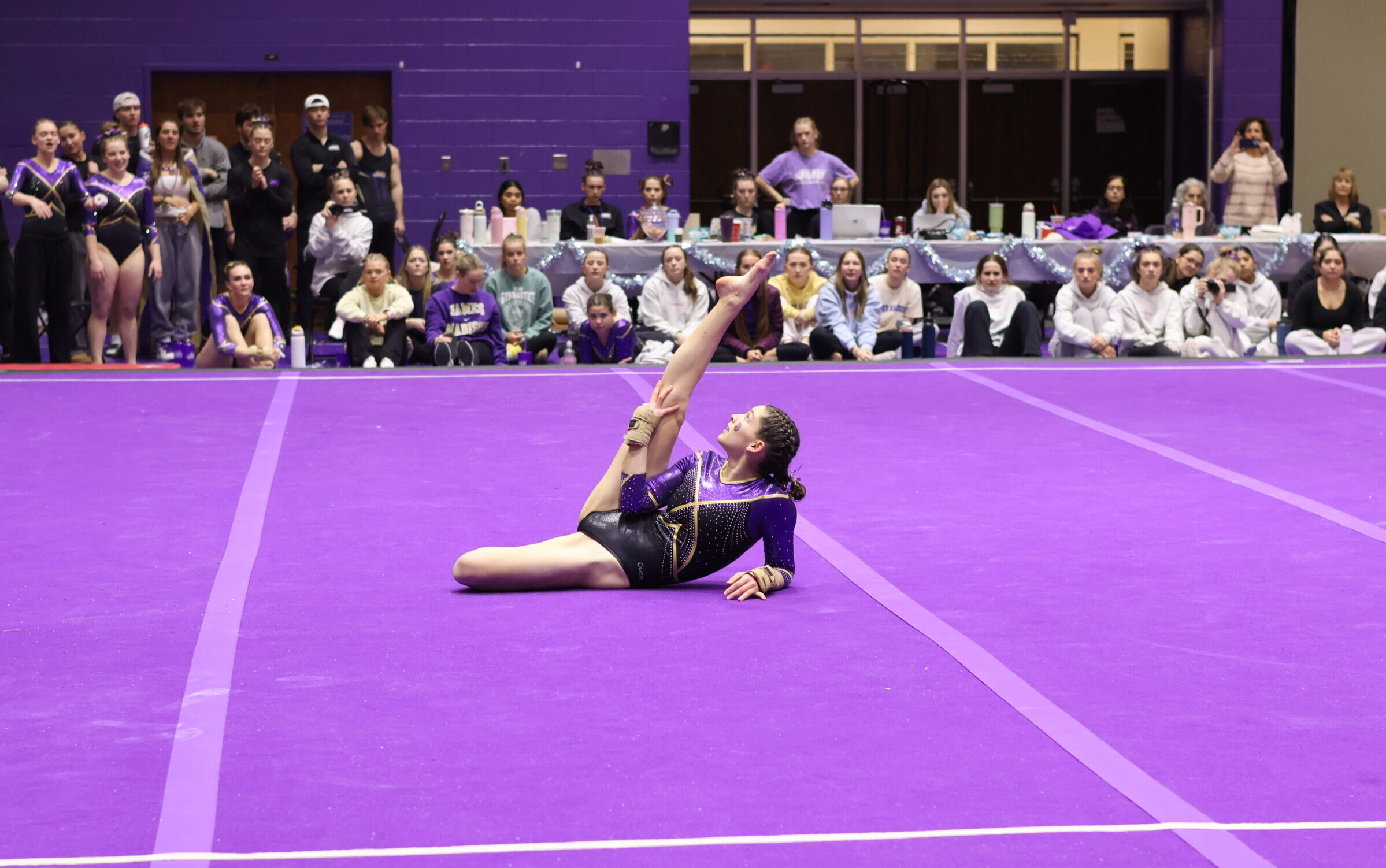
At James Madison University, one of the largest club teams in the NAIGC, that balance between competition and community is on full display.
The JMU club gymnastics team has grown to include around 100 athletes, with gymnasts competing across multiple levels.
For Emily Young, vice president of the team, returning to gymnastics wasn’t something she ever expected.
Young was already a Level 9 gymnast at just 12 years old, but a career-ending back injury forced her to walk away from the sport. Gymnastics stayed in her past for six years — until she stumbled upon James Madison University’s club gymnastics team.
What she found was a completely different experience than the one she remembered growing up in the sport.
Practices were filled with teammates cheering for one another, athletes training at different levels side by side and a sense that people were in the gym simply because they wanted to be there.
“Creating an environment where people actually want to come and do gymnastics really inspired me,” Young said.
Now in a leadership role herself, Young hopes to continue building that same experience for future members of the team.
“I want to lead with my heart,” she said, “and continue to create that welcoming experience that I didn’t have when I was a child.”
Former JMU club president Leyjah Hamrick has seen the team evolve firsthand.
When Hamrick joined the team during her freshman year, the program had around 40 members. In the years since, it has grown to include more than 100 athletes.
“I think the inclusivity is unreal,” Hamrick said. “There is a place for everyone, whether you’re just starting or whether you’ve done the sport your entire life.”
That sense of inclusivity is one of the core principles of the NAIGC.
The organization offers multiple levels of competition designed to accommodate athletes of varying skill levels, allowing competitors to perform routines that match their experience while still participating in a structured competition environment.
For many gymnasts, that flexibility makes it possible to rediscover the sport in a way that feels sustainable and rewarding.
“Even if you thought you were done with gymnastics, you still miss the feeling of being in the gym,” Hamrick said. “This gives people a chance to come back and experience that again.”
The Scale of NAIGC Nationals
Each season culminates in the NAIGC National Championships, one of the largest gymnastics competitions in the country.
This year’s national championships will bring together 1,500+ athletes from around the country. The event will take place in six gyms and feature seven levels of competition in women’s artistic gymnastics, men’s artistic gymnastics and trampoline and tumbling.
But NAIGC Nationals also features a competition format that is nearly unheard of in traditional gymnastics.
One of the most unique aspects of NAIGC competition is the opportunity for athletes to compete across multiple disciplines, including events traditionally separated by gender in other gymnastics organizations.
Through the Decathlon and Omnithon, athletes can compete on all men’s and women’s artistic gymnastics events, as well as trampoline and tumbling.
That means a single athlete can perform on the six men’s events — floor exercise, pommel horse, still rings, vault, parallel bars and horizontal bar — as well as the four women’s events — vault, uneven bars, balance beam and floor exercise — before adding trampoline and tumbling events into the mix.
The result is a 13-event challenge that celebrates versatility across the entire sport.
According to Shrushansky, the format reflects the organization’s broader philosophy of inclusivity and accessibility.
“People wanted the opportunity to compete on any event they wanted,” Shrushansky said. “So the decathlon became a way for athletes to fully embrace that and compete across everything gymnastics has to offer.”
The Omnithon takes that idea even further, combining men’s and women’s artistic gymnastics with trampoline and tumbling into one of the most demanding and unique challenges in the sport.
In an organization built on flexibility and athlete choice, it represents the ultimate expression of NAIGC’s philosophy: gymnastics without boundaries.
For many gymnasts, the sheer size of the competition is unlike anything they experienced growing up in the sport.
“You have hundreds of athletes in each level,” Shrushansky said. “You actually have a better chance of placing at NCAA Championships than you do at NAIGC Nationals.”
Athletes compete across multiple sessions over several days, with competitors from dozens of teams sharing the competition floor. The environment blends high-level gymnastics with a sense of camaraderie rarely seen in traditional competitions.
“You’ll see former NCAA athletes competing alongside people who just learned a cartwheel a year ago,” Shrushansky said. “That’s what makes it special.”
As the NAIGC continues to grow, it is reshaping the idea of what a gymnastics career can look like.
For some athletes, it provides a second chance to compete after injuries or burnout forced them away from the sport. For others, it offers a first opportunity to experience gymnastics in a competitive environment.
What unites them is a shared love for the sport. At competitions across the country — and especially at Nationals — that passion is on full display.
Thousands of athletes take the floor not because they are chasing scholarships or Olympic dreams, but simply because they want to keep doing gymnastics.
And in the NAIGC, that is more than enough.
For More: Purpose Over Podium, NAIGC Gymnastics Omnithon Superwoman Angela Fuller Inspired By Chellsie Memmel



Leave A Comment
You must be logged in to post a comment.