
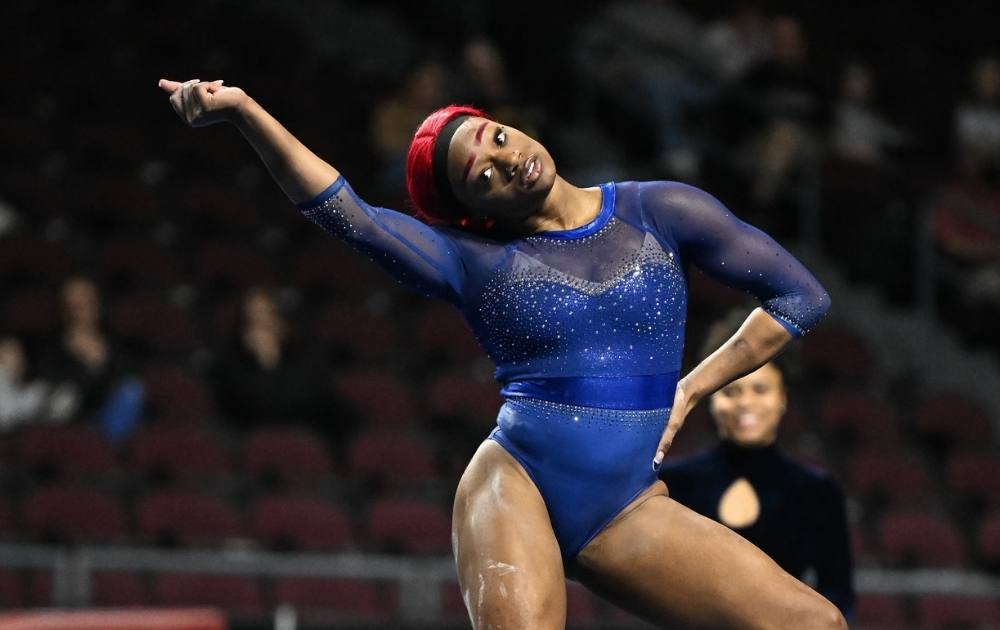
Less than a year ago, Morgan Price stood atop the Women’s Collegiate Gymnastics National Invitational Championships (WCGNIC) podium, celebrating a historic feat – she had just become the first gymnast from any program to sweep the all-around and event titles at the meet.
Price’s sweep was historic and represented just how far HBCU gymnastics has come since Fisk – the first HBCU gymnastics program – first took the competition floor back in 2023.
Today, Price is breaking records for Arkansas, and Fisk is quickly barreling through its final season as a program. Not long ago, HBCU gymnastics looked to be on top of the world, so what went wrong? And what does the future of gymnastics at historically Black colleges look like today?
The First HBCU Gymnastics Team
In 2022, Nashville’s Fisk University announced that it was partnering with advocacy organization Brown Girls Do Gymnastics (BGDG) to create the first-ever HBCU gymnastics team to compete at the NCAA level.
“We were originally looking for the larger HBCUs, the D1 programs, because we wanted the gymnasts to immediately be able to compete in the NCAA championship,” said Derrin Moore, Founding Director of BGDG. (Fisk is part of the NAIA, but competes at the NCAA Division II level in gymnastics.)
“Fisk reached out to us,” she continued.
Lacking a home gym, Fisk only competed in away meets during its inaugural season, including long trips to Nevada, Michigan, and New Jersey. The Bulldogs also had to train at Nashville Gymnastics Training Center, nearly seven miles away from Fisk’s North Nashville campus.
Despite the unusual circumstances, Fisk was still able to attract top talent to its program, highlighting the undeniable appeal of HBCU programs to Black and Brown gymnasts.
“Fisk has always been one of the Ivies of the HBCUs. Even if you were looking at a larger school, the name ‘Fisk,’ coupled with having gymnastics, made recruiting a lot easier for them,” said Moore, whose organization hosts camps and conferences targeted toward Black and Brown gymnasts.
The inaugural Bulldogs squad thrived. Fisk’s first USAG Championships appearance saw Price be named the first-ever HBCU All-American while teammate Liberty Mora picked up a podium finish on beam.
The hype built in Fisk’s first season seemed like a building block, both for a strong program in Nashville and a nationwide HBCU gymnastics movement.
Programs Come and Go
Less than a month after Fisk’s debut, Talladega College became the second HBCU to announce its intention to field a gymnastics team.
Much like Fisk, the Talladega Tornadoes’ debut season was away meets only, but saw a fair deal of success, including an upset of Division I Alaska. Freshman Kyrstin Johnson was a highlight, winning the vault title at USAG nationals.
The success was short-lived, though. In July 2024, after just one competitive season, Talladega announced it was cutting the program, citing financial difficulties.
While the team attempted to crowdfund the $500,000 necessary to keep itself afloat, they fell well short of their goal, making the university’s decision final.
12 of the 15 non-graduating gymnasts on Talladega’s roster hit the transfer portal, with seven heading to Ohio to join the newly announced program at Wilberforce University.
Wilberforce may be the most ambitious HBCU program yet. The university has 15 buildings on campus and enrolls only 811 students. They do have a home gym, but have only utilized it once – for a tri-meet with Fisk and Greenville.
The End of Fisk Gymnastics
In June 2025, HBCU gymnastics took a major blow when Fisk announced that it would be shutting down its program at the conclusion of the 2026 season, citing similar financial difficulties as Talladega.
“I feel like a lot of time we felt kind of blindsided by the administration,” said Fisk graduate Niamah Muhammad – the gymnast who performed the program’s first-ever routine.
Muhammad, who had graduated by the time the team was cut, found out about the decision not from a coach or administrator, but from a freshman on the team through the team’s group chat.
“We didn’t ever expect them to completely try to shut us down,” Muhammad said.
Moore agrees, saying she heard rumors about the program being cut in the days leading up to the official announcement, but found them hard to believe after such a successful season.
“Completely blindsided,” Moore described her reaction.
What Went Wrong?
The HBCU Gymnastics Alliance’s website was able to sum up the Achilles heel of HBCU gymnastics in just one sentence:
“These pioneering programs were never meant to stand alone.”
The total combined enrollment of Fisk, Talladega, and Wilberforce would fill less than a third of reigning champion Oklahoma’s Lloyd Noble Center.
While Fisk’s success on the competition floor wowed gymnastics fans, it was not enough to convince any larger schools to bite on the idea of starting their own teams.
Even if Fisk had been able to hold home meets at the on-campus Henderson A. Johnson Arena, there is little precedent to suggest that they would have been well attended, with the Bulldogs’ men’s basketball team averaging just over 300 spectators per home game during the 2024-25 season. Talladega was in an even more dire position – its home women’s basketball games averaged just 12 spectators in the 2024-25 season.
Gymnastics is inherently an expensive sport that necessitates a significant investment from any college looking to field a team, requiring complex and costly equipment to even begin training.
Alternatively, new programs can outsource their training to a local gym, like Fisk did. This strategy was vital for Clemson and LIU as they attempted to get on their feet in their first seasons, but as the seemingly constant roster turnover at LIU suggests, asking athletes to commute to a gym off campus may not be a sustainable model long-term.
Constant cross-country trips, the lack of on-campus training facilities, and no true home arena to contribute anything in the way of ticket sales likely contributed to Fisk’s view of the program as an unnecessary expenditure, irrespective of its success.
This was something BGDG aimed to address in helping to set up the programs, but outside factors made the process complicated.
“HBCUs are underfunded. They’re under-resourced, and we know that, and we have so many people on our side who want to see this happen,” said Moore.
“I think the sustainability part is what they’re afraid of, but we’re here for that.”
The Future of HBCU Gymnastics
Pending any announcements, by the end of the season, Wilberforce will be the sole remaining HBCU gymnastics program. Though Wilberforce has the home arena Fisk lacks, the program’s performance does not signal long-term viability; the Bulldogs ranked last among all college gymnastics teams last season with an NQS over 5 points below second-to-last Hamline.
The loss of Fisk’s program will undoubtedly cause a transfer portal cascade similar to when Talladega discontinued its team, though Fisk’s current roster only contains six non-seniors.
On the bright side, HBCU gymnastics programs did have an undeniable recruiting sway with Black and Brown gymnasts.
Muhammad, herself a transfer from Brockport, highlighted the level of talent programs like Fisk were able to attract – “We have national champions, All-Americans, and girls that compete internationally.”
Moore thinks the perseverance of Fisk’s gymnasts shows that there is still a market for HBCU gymnastics, saying, “To have [three] freshmen [competing] now, knowing that the program is probably not gonna be there next year, that speaks a lot to being able to recruit gymnasts.”
If another, larger HBCU wanted to sponsor gymnastics, there is plenty of reason to believe that they could be successful, but it is critical to focus on attracting programs with more resources than sub-1500-student private schools.
However, as programs continue to come and go around them, Wilberforce president Dr. Vann R. Newkirk – who was formerly the president of Fisk – reasserted his commitment to the program in a video posted shortly after Fisk’s announcement.
“We are like granite. Our program is tough. We’re looking to win championships,” said Dr. Newkirk.
Moore’s message to Black and Brown gymnasts across the country is similarly clear: “If you want to go to an HBCU and you wanna do gymnastics, do it… You’re not gonna get what you can get from HBCUs anywhere else.”
This type of mindset may be what is necessary to keep Wilberforce afloat until more HBCUs sponsor gymnastics teams. For now, the Bulldogs are the last ones standing.




Leave A Comment
You must be logged in to post a comment.